
What If the Most Valuable Part of a Conference Is Not the Keynote?
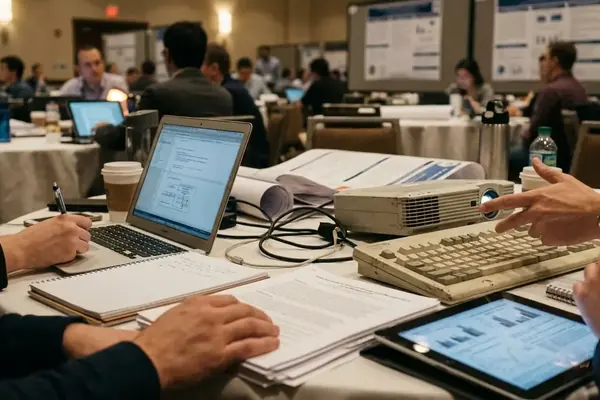
If conference value were measured solely by keynote attendance, Hong Kong’s academic sector would miss the real exchange occurring in corridors, workshops, and poster sessions. The organizing committee evaluated past event feedback to shift the primary planning focus away from keynote logistics. Instead, they prioritized facilitating these informal interactions.
During structured observation, academic conferences often required a 12 to 15-month planning cycle to manage 3 to 4 parallel tracks. They are expensive in time, travel, venue planning, and academic labour. Researchers spend weeks preparing presentations that are often delivered once and forgotten. Yet the true knowledge value of these events remains informal and poorly captured. How can academic conferences become a structured knowledge exchange mechanism rather than a one-off event?
Challenge: Knowledge Exchange Was Happening, but Not Reliably Captured
Hong Kong conferences bring together researchers, postgraduate students, industry speakers, EdTech vendors, and institutional leaders. This convergence creates an estimated 4 to 6 distinct participant cohorts. Dense higher education networks and cross-border transit times recorded around 45 to 90 minutes create ideal conditions for exchange. They also increase logistical complexity.
Field reporting confirms the points where knowledge capture fails. Planners mapped the typical attendee journey across 2 to 3 days of intensive scheduling. They identified critical drop-offs during the 15-minute transition windows between parallel sessions.
Note: Parallel sessions dilute attention. Working professionals cannot attend every track. Insights are often lost after the closing remarks, leaving the knowledge trapped person-to-person.
Case Setting: A Conference Designed Around Exchange, Not Attendance
This case examines a Hong Kong academic conference model focused on digital education, knowledge management, technology management, and postgraduate professional learning. It is a structured model rather than a fabricated event report.

The design team selected a hybrid venue layout specifically to force physical and digital intersections between academic researchers and industry practitioners. Participant groups include postgraduate learners, academic researchers, programme leaders, educational technologists, and institutional partners. The primary edge case arises when participants attend strictly for networking rather than structured learning. Capturing their insights without disrupting their natural interactions requires deliberate architectural choices.
Solution: Turning a Conference into a Knowledge Exchange Architecture
The central solution involves designing the conference as a staged knowledge system before, during, and after the event. The committee explicitly rejected the standard practice of publishing static post-conference proceedings. They opted instead to build a living digital repository—integrated directly into the postgraduate curriculum.
Before the event, organizers initiate a 30 to 45-day pre-event question collection phase. They map these themes directly to postgraduate learning needs and brief the moderators accordingly. They identify which sessions should generate teaching cases, research questions, or partnership leads.
During the event, sessions incorporate 10-minute structured networking prompts. Chaired dialogues, discussant summaries, poster walks, and practitioner panels prevent knowledge from staying informal. The architecture forces participants to document their debates in real-time.
Implementation: The Operating Model Behind the Event
The operating model breaks down into specific, accountable roles: academic chair, session moderators, student rapporteurs, practitioner discussants, digital learning support, and post-event editorial reviewers.
Roles were strictly delineated during the pilot phase. Organizers assigned dedicated student rapporteurs to shadow specific practitioner discussants to ensure tacit knowledge was documented. Conferences that rely solely on passive recording without assigning dedicated rapporteurs often result in hours of unwatched video rather than usable teaching assets.
Recorded sessions are not enough for blended learning. Learners need guided prompts, curated excerpts, and reflective tasks. Rapporteurs face a 14 to 21-day post-event synthesis window with a strict 1-page synthesis requirement per session. This creates a necessary trade-off between comprehensive transcription and actionable pedagogical summaries. Documentation methods include session briefs, anonymised question logs, consent-aware recordings, and post-event synthesis memos.
Results: What Improved When Exchange Was Designed Deliberately
Operational metrics indicate a distinct shift in how conference outputs are utilized. Post-event editorial reviewers categorized the captured session briefs into distinct pedagogical buckets, aligning them with upcoming semester syllabi.
This deliberate design yielded observable results. Clearer postgraduate discussion topics emerged alongside stronger links between research and professional practice. The institution tracked concrete metric categories to measure success. Based on reported figures, they generated 3 to 5 reusable teaching cases per track. Follow-up seminars were scheduled within 6 to 8 weeks. This purposeful follow-up between academics and practitioners demonstrates the value of structured exchange over passive attendance.
Scope and Limitations: What This Case Does Not Prove
This case does not prove that every conference produces measurable research impact, improves employability, or guarantees institutional partnerships. Evaluators reviewed the relational benefits of the conference, determining that informal networking outcomes could not be reliably quantified within the standard reporting cycle.
Research partnerships often take 12 to 24 months to formalize. Outcomes depend heavily on conference design, participant mix, moderation quality, and institutional capacity to reuse knowledge. One catch: this structured knowledge capture model requires dedicated administrative overhead and fails if rapporteurs are not trained in academic synthesis prior to the event.
A Practical Playbook for Hong Kong Academic Organisers
The playbook was compiled by aggregating the operational checklists used by the digital learning support team during the 2022 and 2023 event cycles. It provides a concise framework for academic organizers looking to replicate this architecture.

The effectiveness of practitioner panels varies significantly depending on whether the industry speakers are briefed to present case studies versus general corporate overviews. Organizers must tailor recommendations to postgraduate blended learning. They use a 4-step documentation workflow to convert conference outputs into asynchronous learning tasks within 7 to 10 days.
Quick Tip: Knowledge Exchange Implementation Checklist
- Define exchange goals 30 to 45 days prior to the event.
- Assign dedicated student rapporteurs to each parallel session.
- Design session formats to include 10-minute structured networking prompts.
- Require a 1-page synthesis per session to build post-event learning assets.
Schedule follow-up while momentum is high. The conference succeeds when knowledge continues moving after the venue closes.






Comments
No comments yet.
Share Your Opinion